Contact centres are transforming rapidly, and at the heart of that change is contact centre AI. From intelligent virtual agents to real-time agent assistance, AI is helping organisations deliver faster, more personalised, and more efficient customer service than ever before. As AI call center solutions are becoming an advantage, businesses that adopt these technologies can enhance customer experiences while optimising operations and reducing costs.
This guide walks you through what contact centre AI is, how it works, the key benefits, and how you can leverage it to create standout customer experiences.
In today’s business world, staying ahead requires more than just basic customer support. Many companies are exploring innovative computing solutions to power advanced analytics, which can directly improve the performance of contact centres. By integrating these technologies, agents can access customer history instantly, offering personalised assistance that feels natural and responsive.
For enterprises looking for high-performance infrastructure, investing in supercomputer-grade hardware for AI workloads allows contact centres to process vast amounts of data quickly, enabling smarter routing, predictive support, and more efficient issue resolution. These upgrades aren’t just technical—they enhance the overall customer journey by reducing wait times and ensuring accuracy in every interaction.
Marketing strategies also play a crucial role in maximising the impact of contact centre AI. Leveraging insights from marketing strategies designed for customer engagement ensures that communication remains targeted and relevant, reinforcing trust and loyalty. Even partial adoption, such as integrating AI-driven recommendations into campaigns, can deliver significant returns over time.
For teams focused on scaling outreach and improving digital touchpoints, platforms like Marketing Runners’ insights on automation provide actionable tips to align AI-driven contact centres with broader marketing initiatives. This coordination ensures a seamless experience from first touch to follow-up support, giving customers a unified experience across channels.
Financial planning and operational optimisation are also essential. By using top financial resources for tech investments, organisations can budget effectively for AI integration, ensuring that both software and hardware upgrades are sustainable while delivering measurable ROI. This approach allows companies to expand their contact centre capabilities without compromising service quality.
By combining these advanced technologies, marketing insights, and financial strategies, businesses can fully leverage contact centre AI to create efficient, customer-focused operations. The result is a support system that is not only faster and smarter but also more human, building lasting relationships with every interaction.
Top 10 Contact Centre AI Solutions for Modern Businesses
Choosing the right contact centre AI platform is essential for improving customer experience, automating repetitive tasks, and supporting agents with intelligent tools. Here’s a list of the top solutions that can transform your contact centre operations:
1. Bright Pattern
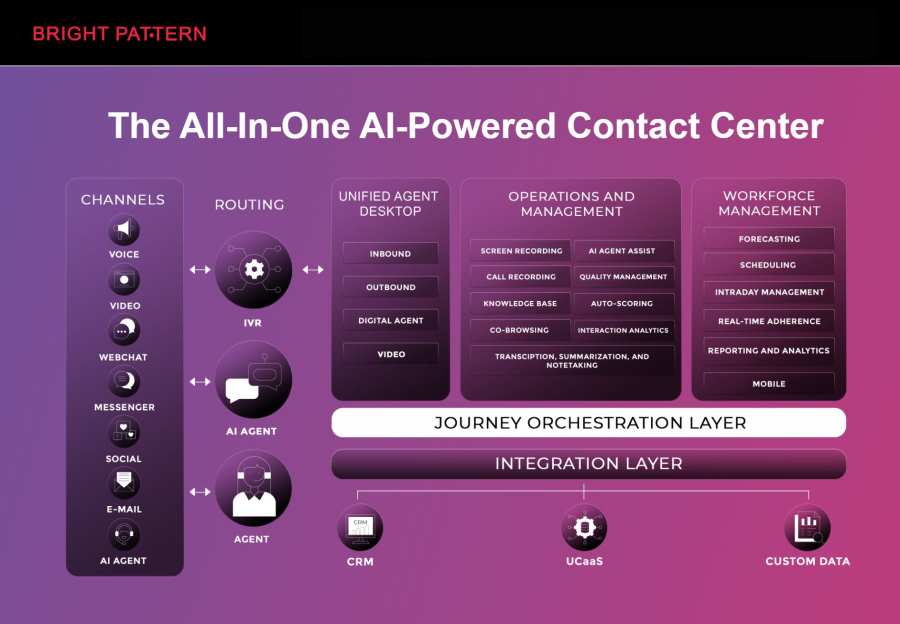
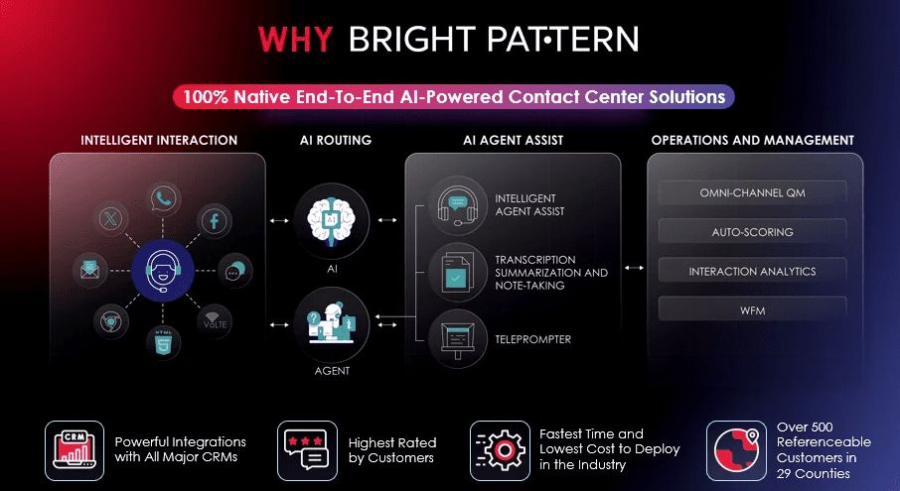
Bright Pattern stands out as a leading provider of contact centre AI, offering a robust, cloud-based platform that integrates AI-powered automation with human agent support. Businesses across industries use Bright Pattern to enhance customer interactions, streamline workflows, and increase agent productivity.
Key features of Bright Pattern contact centre AI include:
- AI-driven chatbots and virtual agents for instant customer support
- Omnichannel support including voice, chat, email, SMS, and social media
- Real-time agent assistance with AI suggestions
- Intelligent routing and predictive analytics for faster issue resolution
- Customisable dashboards and reporting for operational insights
Many organisations choose Bright Pattern because it combines advanced AI capabilities with user-friendly tools that make deploying and scaling contact centre solutions straightforward. Its flexibility ensures that businesses can adapt quickly to changing customer needs while maintaining high-quality service.
2. Genesys
Genesys provides a comprehensive contact centre AI platform that focuses on predictive engagement, AI-powered self-service, and seamless omnichannel communication.
3. Five9
Five9 uses cloud-based AI solutions to automate routine tasks, provide real-time agent support, and improve customer experience through intelligent routing.
4. NICE inContact
NICE inContact offers AI-driven analytics, virtual assistants, and automation tools that empower agents to deliver personalised support while optimising operations.
5. Talkdesk
Talkdesk’s contact centre AI platform includes machine learning, natural language processing, and sentiment analysis to create more efficient and meaningful customer interactions.
6. Avaya
Avaya provides AI-integrated contact centre solutions that combine speech recognition, predictive routing, and virtual agent capabilities to improve customer satisfaction.
7. RingCentral
RingCentral Contact Centre AI leverages automation and real-time analytics to enhance both agent productivity and customer engagement across multiple channels.
8. Cisco Webex Contact Centre
Cisco Webex Contact Centre incorporates AI-powered workforce optimisation, chatbots, and real-time agent guidance to streamline service delivery.
9. Aspect
Aspect’s AI-enabled contact centre software focuses on customer self-service, intelligent routing, and analytics to improve operational efficiency.
10. 8x8
8x8 provides a cloud contact centre AI platform that combines AI chatbots, predictive analytics, and omnichannel support to deliver consistent, high-quality service.
What Is Contact Centre AI?
Contact centre AIrefers to the use of artificial intelligence technologies to automate, assist, and optimise interactions between customers and your support team across phone, chat, email, and digital channels.
It typically combines several capabilities, including:
- Natural language understanding (NLU)to understand what customers are asking in their own words.
- Machine learningto continuously improve responses and routing based on data.
- Speech recognitionto turn voice conversations into text that machines can analyse.
- Predictive analyticsto anticipate customer needs and recommend next best actions.
- Automation and orchestrationto complete tasks end to end without human intervention.
Instead of replacing humans, contact centre AI acts as aforce multiplierfor your team: handling routine work, surfacing insights, and enabling agents to focus on high-value conversations.
Core Components of Contact Centre AI
Most modern AI-powered contact centres use a combination of the following components:
1. Virtual Agents and Chatbots
Virtual agents(or intelligent chatbots) are AI-powered assistants that can converse with customers over voice or chat. They can:
- Answer common questions instantly, 24 / 7.
- Authenticate customers and gather key information before routing.
- Perform routine actions such as order status checks, password resets, and appointment scheduling.
- Hand off seamlessly to human agents when needed, passing along full context.
2. AI-Powered Self-Service
AI enhances traditional self-service by understandingintentrather than relying only on rigid menus or keyword searches. Customers can simply ask, in natural language, what they need, and the system can guide them to the right answer or process.
- Search that understands synonyms, typos, and conversational phrasing.
- Dynamic FAQs that update based on real customer behaviour.
- Guided workflows that adapt based on previous steps in the interaction.
3. Agent Assist and Co-Pilot Tools
Agent assisttools support live agents in real time while they talk, chat, or email with customers. These tools can:
- Listen to or read the conversation as it happens.
- Suggest responses, knowledge articles, and next steps.
- Auto-summarise interactions for faster after-call work.
- Highlight compliance reminders or key phrases to mention.
4. AI Routing and Workforce Optimisation
AI can make smarter decisions aboutwhoshould handle each interaction andwhen. It can:
- Route customers based on intent, value, urgency, and sentiment.
- Match customers with agents based on skills, language, and past success rates.
- Forecast demand more accurately for staffing and scheduling.
- Recommend proactive outreach to prevent issues before they occur.
5. Analytics, Insights, and Quality Management
Because AI can analyse every single interaction, it opens up powerful new insights:
- Automatic transcription and analysis of calls.
- Theme and trend detection across all channels.
- Automated quality scoring and coaching suggestions.
- Sentiment and emotion analysis to understand customer reactions.
Key Benefits of Contact Centre AI
Organisations adopt contact centre AI for a wide range of reasons, but the benefits usually fall into three main categories: better customer experiences, more empowered agents, and stronger business performance.
1. Better, Faster Customer Experiences
- 24 / 7 availabilityso customers can get help whenever they need it, even outside business hours.
- Instant answersto common questions, reducing wait times dramatically.
- Personalised interactionsthat account for customer history, preferences, and context.
- Omnichannel consistencyso customers receive high-quality support across phone, chat, email, messaging, and social channels.
Customers notice when service feels effortless and tailored to them. AI makes that level of service sustainable and scalable.
2. Happier, More Productive Agents
- Less repetitive workas AI handles routine questions and tasks.
- Real-time guidancethat reduces stress and helps newer agents ramp up quickly.
- Automatic notes and summariesthat streamline after-call work and administration.
- More meaningful conversationsas agents focus on complex, relationship-building interactions.
When agents feel supported by smart tools rather than overwhelmed by volume, they deliver better service and are more likely to stay with your organisation.
3. Stronger Business Performance
- Lower cost per contactthrough automation and better first contact resolution.
- Higher customer satisfaction (CSAT)andNet Promoter Score (NPS)through faster, more accurate support.
- Improved sales and conversionthrough timely recommendations and cross-sell or upsell assistance.
- Data-driven decisionsbased on interaction analytics rather than guesswork.
Over time, these improvements compound, turning the contact centre from a cost centre into a strategic growth driver.
Contact Centre AI Capabilities at a Glance
|
Capability |
What it does |
Key benefit |
|
Virtual agents |
Automate routine customer conversations via voice or chat. |
Always-on support, reduced wait times, lower handling costs. |
|
Agent assist |
Provide real-time guidance, suggestions, and summaries for agents. |
Higher quality interactions, faster resolution, less agent effort. |
|
AI routing |
Match customers to the best available resource based on data. |
Better first contact resolution, improved customer experience. |
|
Interaction analytics |
Analyse every call, chat, and email for themes and sentiment. |
Actionable insights, targeted improvements, informed strategy. |
|
Self-service search |
Use AI to surface the best answers and guides. |
Higher self-service success, less inbound volume. |
High-Impact Use Cases for Contact Centre AI
While AI can touch almost every part of the contact centre, some use cases show value especially quickly.
1. Handling High-Volume, Repetitive Enquiries
Common examples include:
- Order status and delivery updates.
- Billing questions and payment confirmations.
- Account balance or usage checks.
- Appointment booking, rescheduling, and cancellations.
Virtual agents can manage these interactions end to end, freeing human agents for more complex situations.
2. Intelligent Call and Chat Routing
Instead of relying only on traditional IVR menus or simple rules, AI routing can:
- Identify the customer intent from their first sentence.
- Evaluate factors like customer history, lifetime value, and sentiment.
- Choose the best agent or queue in real time.
The result is faster resolution, fewer transfers, and a smoother experience for both customers and agents.
3. Real-Time Agent Coaching
Agent assist solutions can coach agents live during conversations. They may:
- Suggest compliant language for regulated industries.
- Surface relevant knowledge base articles instantly.
- Highlight upsell or cross-sell opportunities.
- Guide the agent through complex troubleshooting flows.
This is especially powerful for new hires, helping them become confident much faster than with traditional training alone.
4. Automated After-Call Work and Summaries
AI can listen to or read the conversation and auto-generate:
- Call or chat summaries.
- Disposition codes and wrap-up notes.
- Follow-up tasks or case updates.
This reduces admin time while also creating more consistent, detailed records for future reference and analysis.
5. Voice of the Customer and Continuous Improvement
By analysing all interactions across channels, contact centre AI can help you:
- Discover recurring pain points that customers face.
- Prioritise fixes and enhancements with the biggest impact.
- Track the effect of changes on customer sentiment and outcomes.
- Identify new product or service opportunities.
This turns your contact centre into a powerful feedback engine that directly informs business strategy.
How to Get Started with Contact Centre AI
Adopting contact centre AI does not have to be a massive, all-at-once project. Many organisations see strong results with a phased approach.
Step 1: Clarify Goals and Success Metrics
Begin by definingwhatyou want AI to achieve. For example:
- Reduce average handle time for specific enquiry types.
- Increase self-service containment rate for common questions.
- Boost first contact resolution on key journeys.
- Improve CSAT or NPS by a specific percentage.
Clear goals keep projects focused and make it easier to demonstrate value.
Step 2: Identify High-Value, Low-Risk Use Cases
Look for processes that are:
- High volume and repetitive.
- Well understood and documented.
- Low complexity and low risk.
These are ideal starting points for virtual agents, AI routing, or self-service enhancements.
Step 3: Prepare Your Data and Knowledge
AI performs best when it has access to accurate, well-structured information. Focus on:
- Updating and organising your knowledge base.
- Ensuring customer records and interaction histories are accessible.
- Standardising process documentation and scripts.
Clean data and clear content dramatically improve the quality of AI responses and recommendations.
Step 4: Start Small, Then Scale
Launch pilot projects with a limited scope and audience, such as:
- A virtual agent for a single, common enquiry type.
- Agent assist for one team or one product line.
- AI analytics on a particular channel or queue.
Collect feedback, refine the experience, and then expand to additional use cases and channels as you see results.
Step 5: Involve Your Agents Early
Agents are central to the success of contact centre AI. Involve them by:
- Explaining how AI will support their work, not replace it.
- Inviting them to suggest processes for automation or assistance.
- Using their feedback to improve AI responses and flows.
- Recognising and rewarding agents who embrace the new tools.
When agents feel ownership and see personal benefits, adoption rates rise and performance improves.
Measuring the Impact of Contact Centre AI
To fully capture the value of contact centre AI, track metrics across customer experience, operational efficiency, and employee satisfaction.
Customer Experience Metrics
- Customer satisfaction (CSAT)after interactions with both AI and human agents.
- Net Promoter Score (NPS)over time as AI capabilities expand.
- First contact resolution (FCR)for key journeys.
- Average speed of answerand virtual agent response times.
Operational Metrics
- Handle timefor AI assisted and non assisted contacts.
- Self-service containment rate(issues fully resolved without an agent).
- Contact volume deflectionfrom human staffed channels.
- Cost per contactacross different interaction types.
Employee Experience Metrics
- Agent satisfaction and engagement scores.
- Agent turnover and tenure.
- Time spent on after-call work.
- Training and ramp-up timefor new agents.
Regularly reviewing these metrics helps you fine-tune AI configurations and identify new opportunities for optimisation.
Future Trends in Contact Centre AI
Contact centre AI is evolving quickly. Several emerging trends are shaping its future:
- More natural, human-like conversationsas language models and speech technologies improve.
- Richer personalisationthat takes into account customer preferences, behaviour, and sentiment in real time.
- Proactive servicewhere AI reaches out to customers to prevent issues before they arise.
- Tighter integrationwith CRM, marketing, and back-office systems for end-to-end automation.
- Embedded AI in agent desktopsas a standard feature rather than an add-on.
Organisations that invest now build the capabilities, data, and culture needed to take full advantage of these advances.
Frequently Asked Questions About Contact Centre AI
Does contact centre AI replace human agents?
Contact centre AI is designed toaugmenthuman agents, not replace them. AI handles routine, predictable interactions and administrative work, while humans focus on complex, emotional, and high-value conversations where empathy and judgment are essential.
How quickly can we see results from contact centre AI?
Many organisations see measurable improvements within weeks or a few months of launching targeted AI use cases such as virtual agents for common questions or real-time agent assist. The exact timeline depends on your starting point, data readiness, and the scope of your initial projects.
Is contact centre AI only for large enterprises?
No. While large enterprises were early adopters, modern cloud-based solutions make AI accessible to organisations of all sizes. Smaller teams often benefit from faster decision making and can move quickly to implement focused, high-impact use cases.
What skills do we need to manage contact centre AI?
You will benefit from a mix of skills, including customer journey design, analytics, contact centre operations, and basic understanding of AI capabilities. Many platforms are designed so that non technical teams can configure flows, review analytics, and iterate without deep coding expertise.
Putting It All Together
Contact centre AI is a powerful enabler for organisations that want to deliver standout customer experiences, unlock new levels of agent productivity, and run their operations more intelligently.
By starting with clear goals, choosing practical use cases, preparing your data and knowledge, and partnering closely with your agents, you can build an AI enhanced contact centre that is faster, more flexible, and more rewarding for everyone involved.
The contact centre is no longer just a place where problems are solved. With the right AI strategy, it becomes a proactive, insight-rich hub that drives loyalty, growth, and long-term customer relationships.
